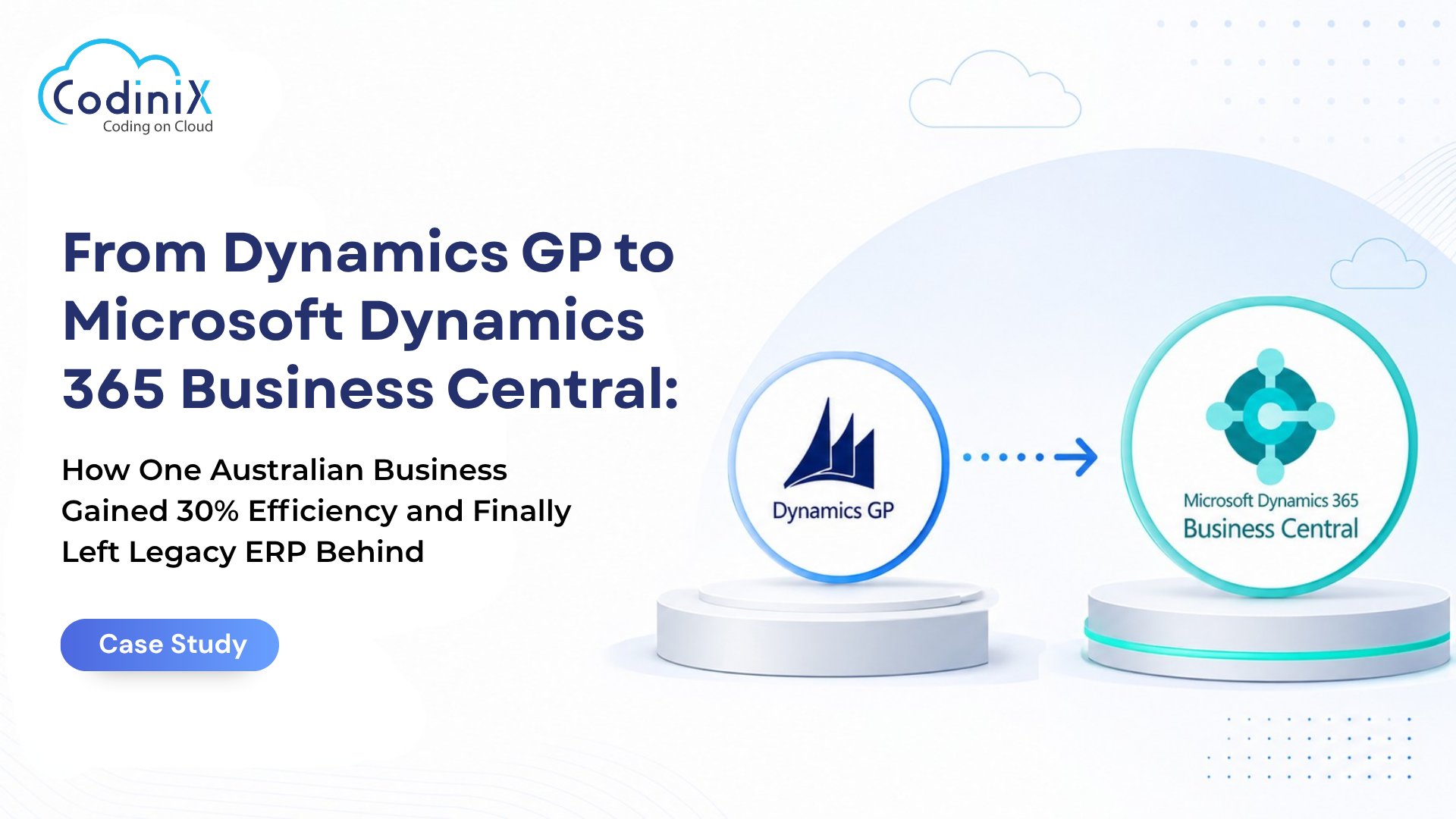
From Dynamics GP to Microsoft Dynamics 365 Business Central: How One Australian Business Gained 30% Efficiency and Finally Left Legacy ERP Behind
From Dynamics GP to Microsoft Dynamics 365 Business Central: How One Australian Business Gained 30% Efficiency and Finally Left Legacy ERP Behind
By Admin
07 Aug , 2026
Microsoft Dynamics
The System That Built the Business Was Holding It Back
There is a moment every growing business hits where the tools that got them here are no longer the tools that will take them forward. For this leading Australian company, specializing in tailored solutions for both commercial and residential sectors, that moment had arrived with their long-standing ERP system, Microsoft Dynamics GP.
This was not a failing business. Quite the opposite. They had built a strong reputation for quality and customer satisfaction across two demanding market segments. But behind the scenes, the cracks were showing. The ERP system that had once been the backbone of their operations was now quietly becoming a barrier to the very growth it was supposed to support.
The leadership team knew something had to change. They needed a partner who could not only migrate their data but genuinely transform the way their business operated. They found that partner in Codinix Technologies.
What Was Actually Going Wrong
To understand the impact of what Codinix Technologies delivered, it helps to understand just how deeply the old system was affecting day-to-day operations. These were not minor inconveniences. These were real, compounding problems that touched every part of the business:
Growth had outpaced the platform - Microsoft Dynamics GP was never designed for the scale this business had reached. Every time the team tried to expand, they hit walls that required expensive workarounds or simply could not be crossed at all.
Manual processes were eating time and creating errors - Tasks that should have taken minutes were taking hours. Data had to be entered in multiple places. Reports had to be compiled by hand. Staff were spending their days fighting the system rather than serving customers.
Nobody had a real-time view of the business - When leadership needed to make a decision, they were working with data that was hours or even days old. In a competitive market serving both commercial and residential clients, that lag has real consequences.
Integration with modern tools was a constant struggle - The business had adopted newer applications for project management, customer communication, and reporting, but connecting those tools to Dynamics GP was a technical headache that demanded ongoing effort from the IT team.
The maintenance bill kept climbing - Between licensing, server infrastructure, and the ongoing cost of keeping a legacy system running, the total cost of ownership had grown well beyond what the business was getting in return.
This is a situation we knows intimately. As specialists in Dynamics GP to Business Central Migration and broader ERP transformation, the team had both the knowledge to assess what needed to change and the experience to deliver it cleanly.
The Codinix Approach: Thorough, Tailored, and Built Around the Client
No two migrations are alike, and we do not treat them as if they are. The engagement was built on a structured methodology that combined technical precision with a genuine understanding of how this business actually operated day to day.
1. A Thorough Assessment Before Anything Else
Before a single piece of data was moved, we conducted a comprehensive assessment of the existing GP environment. Every process was mapped. Every integration point was documented. Every customization and workflow the business depended on was identified and evaluated.
This is where deep Microsoft Dynamics 365 Business Central Consulting Services expertise matters most. Understanding what lives inside a GP environment, what is worth carrying forward, what needs to be rebuilt, and what can simply be improved in the transition, requires experience that goes far beyond surface-level technical knowledge.
The assessment also surfaced something valuable: several customizations the client had built in GP existed purely to work around limitations that Business Central does not have. Identifying those early saved the client significant time and cost during the implementation phase.
2. Data Migration Done Right
Data migration is where many ERP projects go wrong. Cut corners here and the new system launches with corrupt records, missing history, or reconciliation errors that take months to untangle.
We used a structured, validated approach to Microsoft Dynamics 365 Business Central Migration that ensured every critical data set arrived accurately and completely. Master data, open transactions, historical records, and financial balances were all migrated and validated against the source before the cutover was signed off. The result was a go-live the business could trust from day one, without the cleanup work that so often follows a rushed migration. Downtime was kept to an absolute minimum, and the business continued operating smoothly through the entire transition.
3. Business Central Configured for This Business, Not Any Business
Out-of-the-box Business Central is a powerful platform. But every business has processes and workflows that are specific to what they do. We applied targeted Business Central Customization Services to align the platform with the way this client actually operates, covering commercial project workflows, residential job management, financial reporting structures, and approval processes.
This is the difference between an ERP that technically works and one that the team actually wants to use. When the system feels like it was built for you rather than adapted from a generic template, adoption happens naturally rather than being forced.
4. Connecting the Digital Ecosystem
One of the biggest frustrations the team had with their old system was the difficulty of getting it to talk to the modern tools they were using. Business Central was designed with connectivity in mind, and we took full advantage of that.
Through structured Business Central Integration Services, the new environment was connected to the business applications the team was already relying on, creating a joined-up digital ecosystem where data flows automatically rather than being re-entered manually. The disconnected, siloed experience of the old setup was replaced with a platform that works as one coherent system.
5. Training That Actually Prepared People
A new system is only as good as the people using it. We invested in training the client's team properly, not just in how to navigate Business Central, but in how to use it effectively for their specific roles. Hands-on sessions, role-specific guidance, and clear reference documentation meant that when the system went live, users were confident rather than anxious. Ongoing Microsoft Dynamics 365 Business Central Support Services were also put in place to make sure the team always had somewhere to turn.
The Results: Real Numbers, Real Impact
The proof of any ERP implementation is in what changes after go-live. For this client, the changes were significant and felt across every level of the organization:
30% increase in operational efficiency: Automated workflows replaced the manual, repetitive tasks that had been consuming staff time, freeing the team to focus on work that actually moves the business forward.
Real-time data access transformed decision-making: Leadership now works from live, accurate information rather than yesterday's reports, enabling faster and more confident decisions across both the commercial and residential sides of the business.
The platform now scales with the business: As the company grows, Business Central grows with it, without the expensive workarounds that came with the legacy GP environment.
Modern tool integration improved productivity across the board: Connected systems eliminated duplicate data entry, manual reconciliation between platforms, and the ongoing IT effort of maintaining fragile integration workarounds.
IT maintenance costs dropped significantly: Moving to a cloud-based Microsoft Dynamics 365 Business Central environment removed the server infrastructure, complex patching cycles, and escalating support costs of running an on-premises system.
Is Your Business in the Same Position?
If you read through the challenges above and found yourself nodding, you are not alone. Many businesses are still running on Microsoft Dynamics GP, managing the same growing list of limitations, paying the same escalating maintenance costs, and wondering when the right time to make the move actually is.
The answer, for most of them, is now.
Whether you are exploring a full Dynamics GP to Business Central Migration, looking for Business Central ERP Consulting to understand your options, or simply want an honest conversation about where your current system is falling short, Codinix Technologies has the experience and the methodology to help.
This Australian client trusted Codinix Technologies with one of the most significant technology decisions their business had ever made. The result was a system that works, a team that is confident using it, and a business that is better positioned for growth than it has ever been.





























Leave Your Thoughts!!