Technology leaders often find themselves caught in a familiar dilemma. There’s always a new product that needs rapid delivery, a digital transformation underway, or there’s simply not enough capacity on the internal team to handle rising demands. Hiring full-time developers takes months, but the project timeline rarely has that kind of flexibility.
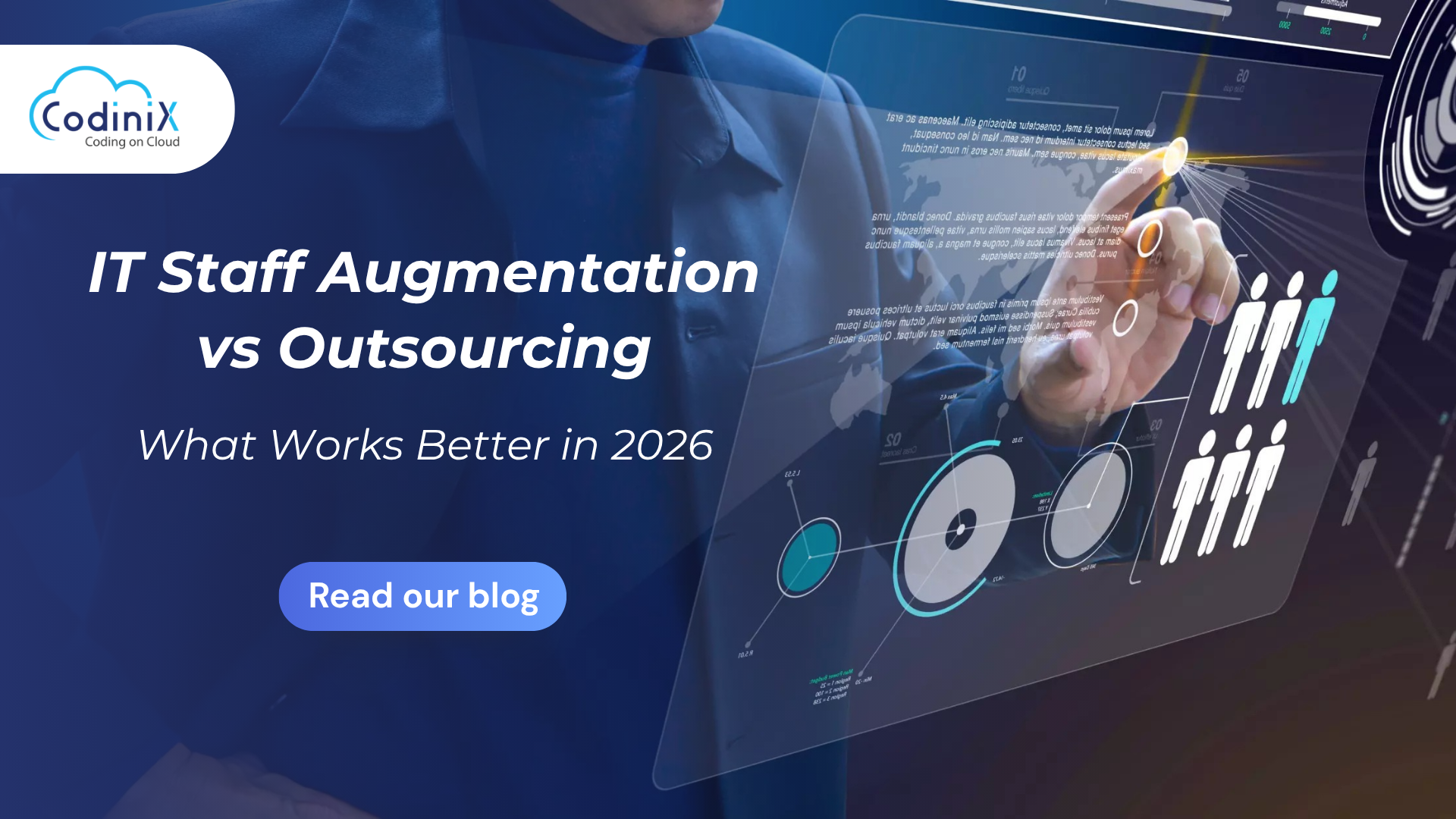
This is where external talent options become crucial. IT staff augmentation and IT outsourcing are among the most common paths businesses take. Both approaches allow companies to bring in skilled tech talent without rushing into permanent hires. Still, they slightly differ in how they operate, the management they offer, and the kind of results they can achieve.
As cloud, AI, and rapid software releases become more deeply embedded in business strategies in 2026, choosing the right model gets even more important. This guide breaks down how staff augmentation and outsourcing work, where each model fits best, and how to pick the one that aligns with your goals.
Why Businesses Are Starting to Rethink Traditional Hiring
The demand for skilled developers, data engineers, cybersecurity experts, and cloud architects keep rising around the globe. At the same time, the fast pace of innovation means companies often need specialist skills for a limited period instead of permanent hires.
Traditional recruitment struggles to keep up in this environment:
- Hiring processes can drag on for months.
- Finding highly specialised talent locally isn’t always an option.
- Technology evolves faster than many organisations can recognise.
- Committing to long-term hires also involves higher operational costs.
Because of these factors, many organisations now turn to more flexible workforce setups. These models help them quickly scale their team and access global expertise. Staff augmentation and outsourcing are among the popular strategies to achieve this agility.
What Does IT Staff Augmentation Mean?
IT staff augmentation involves bringing in external developers or technology experts to temporarily join your in-house team. They work under your supervision and adhere to your existing processes.
Rather than outsourcing the entire project to a separate vendor, you simply include additional talent to extend your in-house team.
For example, a company developing a new SaaS product might opt for:
- Two front-end developers.
- A DevOps engineer.
- A QA automation expert.
These additions integrate directly with the internal team, attend the same meetings, and follow the same project workflows.
Key Characteristics of Staff Augmentation
A few core traits usually define this approach:
- The external developers effectively become a part of your internal team.
- You remain in-charge of managing the project.
- You set priorities, deadlines, and workflows.
- This collaboration can be temporary or long-term.
What Does IT Outsourcing Mean?
IT outsourcing takes a different approach. Instead of just adding more people to your existing team, you hand over an entire project or function to an external provider.
From there, the outsourcing partner handles planning, development, and deployment. Your internal team usually steps in to set the requirements and then review the final results.
For example, an organisation might outsource:
- Development of a mobile application.
- Moving its infrastructure to the cloud.
- Maintaining existing software systems.
In each case, the outsourcing company arranges its own developers, project managers, and workflows to meet the agreed goals.
Key Aspects of Outsourcing
Typical engagements in outsourcing involve:
- An external team managed by the service provider.
- Defined project scope and deliverables.
- Minimal day-to-day involvement from the client’s side.
- A shared sense of responsibility for getting the job done.
Significant Differences between Staff Augmentation & Outsourcing
Both approaches bring in external talent, but how they function can vary quite a bit.
Control and Management: Staff augmentation lets your organisation keep complete oversight of the project. The outsourced developers directly integrate into your existing workflows, use your tools, and follow your reporting standards.
Workforce Integration: Augmented employees become an integral part of your in-house team. They attend stand-ups, collaborate on coding, and get involved in internal decision-making.
Scalability & Adaptability: Staff augmentation is flexible. You can quickly add or remove developers based on what the project demands.
Outsourcing usually ties you to contract terms, where adjusting or renegotiating a contract might be required to change the project demands.
Knowledge Retention: The benefits of knowledge-based staff augmentation is that the knowledge stays within your organisation. External developers work alongside your team, making sure insights aren’t lost.
When IT Staff Augmentation Works Best
Staff augmentation tends to work best when a company already has solid technical leadership in place but needs additional support to execute everything.
Expanding internal workforce
Many businesses turn to staff augmentation when their in-house teams are capable but overloaded. Bringing in a few experienced developers can help speed up project delivery without the hassle of hiring full-time employees.
Evaluating skilled expertise
There are also solutions where specific expertise is only needed temporarily:
- AI or machine learning engineers.
- Cloud migration experts.
- Cybersecurity professionals.
Staff augmentation offers a way to access these skills without committing to long-term contracts.
Supervising complex projects
When it comes to projects involving sensitive information or proprietary systems, companies often want to retain close oversight. Augmented developers can support the work while control remains firmly within the internal team.
Supporting agile development environments
Teams working under agile frameworks often find staff augmentation beneficial because it allows external developers to participate directly in sprint planning, daily stand-ups, and continuous delivery.
What Makes Outsourcing Beneficial
Outsourcing often makes sense when companies want to focus on strategic priorities while leaving the execution to external specialists.
Building individual products or a platform
Outsourcing tends to move faster if deadlines and requirements are clearly laid out in your project. Vendors manage the full spectrum of resources and the development process.
Minimal internal back-ups
For companies with limited internal engineering support, bringing in external developers is a practical way to handle business platforms, mobile apps, or other complex digital projects.
Budgeting perspective
Outsourcing can offer more predictable costs. Contracts might be fixed-price or milestone-based, simplifying financial planning compared to working with many individual developers.
Maintaining older systems
Many organisations outsource the maintenance of legacy systems to help the internal team focus on innovation and modernization.
What’s Trending on 2026
Technology and workforce trends are completely changing how companies consider hiring between staff augmentation and outsourcing.
Remote workforce standardization
Cloud-based development setups and remote collaboration tools facilitate overseeing remotely located teams. This has made staff augmentation a more practical approach since you can bring in experts from across the globe.
Specialised skills on demand
The rise of AI, cloud infrastructure, automation, and advanced analytics are increasingly incorporated in software projects. Companies now demand experts with deep knowledge in these areas, especially when project development starts.
Need for agility
Market demand can shift rapidly. Companies are forced to scale up or down their workforce accordingly. Flexible hiring is a smart business strategy, supporting quick scalability.
Combined strategy
Many businesses are focusing on a hybrid approach. They keep core product development in-house, while outsourcing specific parts, such as individual components or support services.
Finding the Right Fit for your Business
Once you consider a few key points, choosing between staff augmentation and outsourcing becomes easier.
Internal expertise
If you have experienced engineering managers to supervise the workforce, staff augmentation could be a smarter choice.
If you don’t have internal expertise, outsourcing might be the best option because the vendor will manage everything for you.
Your supervision
From architecture decisions to planning sprint, some organisations prefer a thorough supervision. Others focus on the end results and supervise accordingly.
To choose the ideal strategy that works for your management style, it’s important to determine your level of involvement.
Project duration & possibilities
Long-term product development requires augmenting staff, especially when you want external developers to be incorporated in your core team. Outsourcing suits temporary or well-defined projects.
Knowledge retention
You’re keeping valuable expertise in-house by hiring augmented staff. This matters if you desire to have a strong knowledge on your systems and architecture in the future.
Final thoughts
Deciding between IT staff augmentation and outsourcing is not about looking for the universally best choice. Your choice solely depends on your company’s goal, team dynamics, and what your project needs with Codinix Technologies to support you.
By choosing staff augmentation, you enjoy the flexibility in managing and collaborating with the hired team as well as exercising better control over the development operations. Outsourcing, meanwhile, enables focus on strategic priorities by letting the external developers be in charge of execution.
To make your choice easier, you must have the understanding of how your organisation builds, supervises, and scales its technological capabilities.




































Leave Your Thoughts!!